Last updated on 14th May 2026
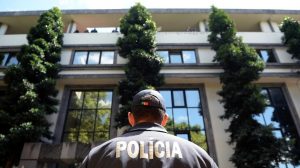
The Forest Police Corps (CPF), under the supervision of the Institute of Forests and Nature Conservation (IFCN, IP-RAM), inspected 5,538 walkers using the classified walking routes in the Autonomous Region of Madeira since the beginning of April, within the scope of the operation to control the payment of the Travel Fee (TPA) and the verification of compliance with the rules of use of the official trails.
According to the Regional Secretariat for Tourism, Environment and Culture, in the same period, 43 administrative offences were raised for non-payment of the compulsory fee to access the classified routes, offences that resulted in €50 on the spot fines.
The TPA inspection kicked off in early April and is currently taking place across various designated routes in the Region. Even before this control model was introduced, the Forest Police Corps had already been conducting checks at the entrances to pedestrian paths, focusing on safety, access control, and raising visitor awareness.
Alongside infractions related to the tourist tax on trails, the IFCN has stepped up monitoring of routes closed for safety or environmental conservation. Since the start of the year, they’ve recorded seven administrative offences for illegal entry into restricted routes, involving eight offenders, each fined €250 on the spot.
Recent cases include PR1 – Vereda do Areeiro, a route that reopened partially on the 1st of May, and since then, five people have been caught walking without paying the mandatory fee.
The Regional Secretary for Tourism, Environment and Culture, Eduardo Jesus, considers that the figures demonstrate “the effective reinforcement of inspection and the monitoring capacity of the classified routes of the Region,” stressing that the main objective is “to ensure the safety of visitors, the sustainable use of the trails and protect Madeira’s heritage.”
“The Continuous growth in demand for pedestrian routes requires increasingly rigorous and responsible management. Madeira has a network of routes, an internationally recognised pedestrian footprint integrated into sensitive natural areas and of high ecological value, so compliance with the rules is essential to preserve these spaces for future generations,” states Eduardo Jesus.
He further reinforces that the measures implemented by the Regional Government do not have a punitive character, but are preventive and pedagogical. “The rules exist to protect people and nature. When a route is closed, this decision is based on technical and safety criteria. ” Ignoring signage, forcing access, or disrespecting interdictions puts human lives at risk and can compromise particularly fragile ecosystems.”
Furthermore, he reiterates that prior registration for use of classified routes must be made through the platform Simplifica, a mechanism that improves the control of load capacity of the tracks, optimises operational management and ensures greater safety for the walkers.
“We want to create an organised, safe and sustainable experience in nature. Prior registration through Simplifica allows us to better understand the visitor flows, strengthen emergency response capacity and ensure the emergency management of our pedestrian routes.”
According to IFCN data, inspection actions have focused on various classified routes, including areas of high tourist demand, such as the Rabaçal, PR6 – Levada das 25 Fontes, PR17 – Caminho do Pináculo and Folhadal, PR12 – Caminho Real da Encumeada, among others.
At the same time, the Forest Police Corps has kept a close watch on the routes temporarily closed, especially after the registration of specific situations, violations of physical barriers and disrespect for existing signage.
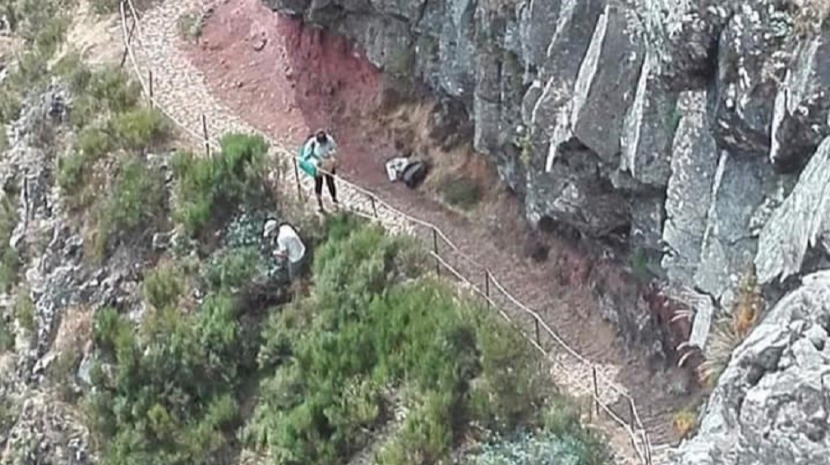
As reported today by DIÁRIO in its print edition, recently, the IFCN even received an anonymous complaint, accompanied by images, concerning the violation of the closure of PR1 – Vereda do Areeiro, between Pico do Arieiro and Pico Ruivo, a situation that included damage to controlled access infrastructure installed by the Institute and which motivated the presentation of a criminal complaint with the Public Prosecutor’s Office.
IFCN President, Manuel Filipe, guarantees that the Forest Police Corps will continue to be “attentive and active” on the ground, arguing that “the law exists to be fulfilled and the closures of the routes are not arbitrary, they are decisions based on safety and environmental conservation criteria.”
Interestingly, a tourism employee mentioned that many people they’ve spoken to are aware of the fee but refuse to pay it, claiming they’ve read online that it’s easy to avoid the authorities due to minimal or no monitoring along the routes.
Samantha Gannon
info at madeira-weekly.com
Views: 195