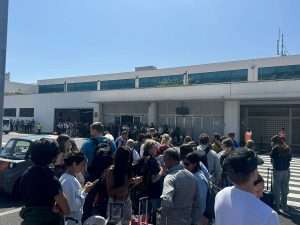
Warnings from leading figures in Madeira’s tourism industry have reignited concerns that the recurring disruption caused by strong winds at Cristiano Ronaldo International Airport is becoming more than an inconvenience for travellers. Industry representatives now fear that the continuing operational difficulties could begin to affect the Region’s economy, airline confidence and long-term accessibility.
Speaking during TSF-Madeira’s Debate of the Week, António Trindade, chairman of the PortoBay Group, warned that some tour operators and airlines are already considering whether to continue operating routes to Madeira in 2027 if the current level of disruption persists.
According to Trindade, the financial burden of repeated diversions, cancellations, and delays has become increasingly difficult for airlines and tour operators to absorb.
“When an aircraft is unable to land, the costs do not end with the diversion,” he explained. “There are additional airport charges, fuel costs, passenger accommodation, meals and operational disruption that can affect aircraft schedules throughout the rest of the day.”
The impact extends beyond the aviation sector. Trindade revealed that PortoBay alone lost around €100,000 in revenue during just three days of airport disruption last month. As the group accounts for only around four per cent of Madeira’s hotel capacity, he suggested the overall economic losses across the Region could be considerably higher.
While tourism businesses are among those most directly affected, Trindade argued that the issue extends far beyond the industry itself.
Residents, he said, increasingly travel with uncertainty over whether they will be able to leave or return to the island on schedule, while businesses face growing concerns over the reliability of Madeira’s principal transport link with mainland Europe.
Rather than commissioning further studies, he believes the priority should now be to bring together airlines, tour operators, hoteliers, maritime operators, travel agencies and public authorities to develop a coordinated contingency strategy.
Former Regional Government vice-president Miguel de Sousa agreed that the situation is becoming increasingly serious but believes responsibility lies deeper than the weather itself. He argues that Madeira lost much of its influence over airport operations after the airport concession passed to ANA, now owned by the Vinci Group.
According to De Sousa, this has limited the Region’s ability to demand investment or influence operational decisions aimed at reducing disruption.
“The airport was ours,” he said, suggesting that decision-making now rests largely with the concessionaire rather than regional authorities.
His comments also raise wider questions over governance and accountability. While airlines, passengers and tourism businesses bear the immediate consequences of airport closures, responsibility for finding long-term solutions is divided between ANA, the Portuguese Government, aviation regulators and the Regional Government.
The discussion also returned to the long-running proposal for a ferry service between Madeira and mainland Portugal.
Miguel de Sousa argued that any successful maritime connection would need to be built around freight transport rather than passengers alone, pointing to the Canary Islands, where cargo provides the economic foundation for regular ferry services. He questioned whether the Port of Funchal has sufficient space to accommodate such an operation, given the growing number of other developments occupying the waterfront.
Trindade agreed that freight would be essential to the commercial viability of any future ferry service but suggested that Porto do Caniçal may offer a more practical long-term solution.
Already equipped with roll-on/roll-off facilities and handling much of Madeira’s commercial freight, he believes the port could form part of a wider contingency plan to improve the Region’s resilience whenever airport operations are disrupted.
The debate comes as researchers from the Portuguese Institute for Atmosphere and Sea (IPMA) and the National Laboratory for Civil Engineering continue investigating changes in wind conditions around Madeira Airport, following reports that average wind speeds have increased in recent years.
If the current pattern of disruption continues, the implications could extend well beyond cancelled flights.
Regular airport closures affect airlines, hotels, restaurants, transport operators, travel agencies, conference organisers and ultimately Madeira’s reputation as a reliable year-round destination. They also have significant consequences for residents, many of whom depend on regular air links for work, healthcare, education and family travel.
As discussions continue over airport resilience, maritime transport and future investment, the central question is no longer simply how to deal with the next period of strong winds. It is whether Madeira can develop a long-term strategy that safeguards the accessibility on which its economy depends.
With airlines reportedly reassessing future operations and tourism leaders calling for urgent action, the issue is increasingly being viewed not as an isolated aviation problem, but as one of the most significant economic and strategic challenges facing the Region.
Samantha Gannon
info at madeira-weekly.com
Views: 23