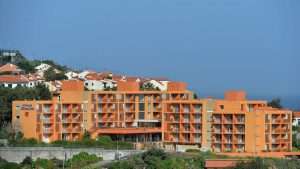
The Portuguese Communist Party (PCP) has called for greater public transparency over the New Hospital of Madeira, expressing concern about rising construction costs, delays to the project and how the remaining work will be funded.
The concerns were raised by a delegation from the PCP’s Regional Directorate during a meeting with the Representative of the Republic for the Autonomous Region of Madeira. Speaking afterwards, the party’s regional coordinator, Edgar Silva, said discussions focused on what he described as the project’s “enormous cost overruns” and the delays affecting its construction.
According to Silva, the procurement model adopted for the project is partly responsible for the current problems. He argued that dividing the development into separate public tenders was “a very serious management error,” for which he holds the Regional Government responsible.
The PCP says it is essential to clarify who will bear the additional costs required to complete the hospital and identify the sources of funding that will cover the increased expenditure. The party is also asking whether the Regional Government has commissioned an updated cost-benefit analysis and when a new environmental impact assessment will be carried out, given the changes made to the original project.
Silva also believes the Portuguese Government should clarify whether it is prepared to contribute towards the additional costs and whether it still considers the New Hospital of Madeira to be a viable project.
The PCP’s regional coordinator also questioned the timetable for completing the hospital, noting that it had originally been expected to become operational in 2024.
“The authorities should have informed the people of this Region long ago when they could expect the New Hospital to open,” he said.
Given the significant public investment involved and the strategic importance of the project for Madeira, the PCP argues that both the Regional Government and the Government of the Republic should provide a full update on the hospital’s progress, its anticipated final cost, and a revised completion date.
Why are large public projects sometimes divided into separate tenders?
The Portuguese Communist Party (PCP) has criticised the Regional Government’s decision to divide the construction of the New Hospital of Madeira into separate public tenders, arguing that this contributed to delays and rising costs.
However, dividing a major public infrastructure project into multiple contracts is a common procurement strategy, both in Portugal and the European Union.
Rather than awarding the entire project to a single contractor, the contracting authority may issue separate tenders for different phases or specialist areas of work, such as earthworks, structural construction, electrical and mechanical systems, medical equipment and landscaping. This approach can encourage greater competition, allow specialist companies to bid for individual elements of the project and, in some cases, reduce overall costs.
The trade-off is that managing multiple contractors is considerably more complex. Delays to one contract can have a knock-on effect on others, while disputes over responsibility, changes to the design or difficulties coordinating different stages of the work can all increase costs and extend construction times.
By contrast, awarding the project to a single main contractor places overall responsibility for delivery with one organisation, simplifying coordination and accountability. However, this approach can reduce competition and may result in higher initial contract prices.
Construction experts generally agree that procurement strategy is only one factor affecting the success of a major project. Cost overruns and delays can also result from inflation in construction materials, labour shortages, design changes, unforeseen engineering challenges and changes to healthcare requirements during construction.
Whether the decision to divide the New Hospital of Madeira into separate tenders ultimately contributed to the project’s difficulties is likely to remain a matter of political debate. Determining the extent of its impact would require a detailed assessment of the project’s procurement, management and construction history.
Samantha Gannon
info at madeira-weekly.com
Views: 5