Artificial intelligence is already helping to predict wind and low cloud at Madeira Airport, University of Madeira researcher Décio Alves told MadIT – Madeira Innovation Talks 2026.
Speaking at the Madeira Congress Centre in Funchal, Alves opened the event’s “Stories with Artificial Intelligence” session with a presentation entitled “The Future Begins at Madeira Airport.”
His talk explored airport weather forecasting, an artificial “meteorologist,” and an unusual experiment in which a digital fruit fly brain learned to land an aircraft.
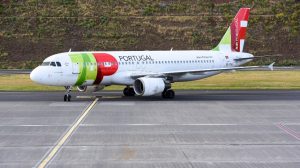
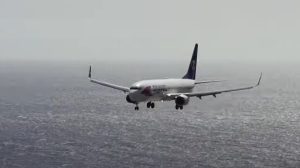
The starting point was one of Madeira Airport’s most familiar challenges: wind.
“We are the best in the world at making short-term wind forecasts,” Alves said.
The team subsequently extended its research to fog and low cloud, which can also disrupt flights. Using data from Europe’s latest-generation weather satellites, the researchers developed a low-cloud forecasting model already used at Madeira Airport.
According to Alves, his team is the only research group in the world using third-generation satellite imagery to predict cloud cover around airports.
However, forecasts still need to be interpreted by meteorologists and pilots. This prompted the team to explore whether AI could take on the meteorologist’s role in refining predictions.
Alves jokingly clarified that he was not referring to a robot, ahead of an appearance by the robot Semilha later in the programme.
For around two months during the summer, the AI system operated alongside meteorologists covering 14 Portuguese airports, without their knowledge, allowing the researchers to compare its performance with human forecasts.
According to the results presented, the human meteorologists achieved 97% accuracy, while the AI system reached 99%.
The greatest difference concerned the identification and correction of forecasting errors. Alves said the meteorologists corrected around 11% of their errors, taking approximately 11 minutes, while the AI corrected almost 70% in around three minutes.
The research could lead to a joint Chinese-Portuguese project involving two Chinese universities, a major airline and the University of Madeira.
Alves then turned to the question of flying the aircraft itself. He described conventional autopilot systems as rigid and dependent on predefined rules.
He said a report in September about the digitisation of a fruit fly’s brain, involving Google DeepMind, had prompted his team to explore the publicly available model.
“Let’s give the fly a plane,” he said.
In a flight simulator recreating Madeira Airport, the team is experimenting with the digital brain model, training it to land an aircraft in windy conditions using forecasts developed by the researchers.
The audience could see the model’s active neurons on screen alongside the simulated aircraft. However, the live demonstration did not go to plan.
“The fly is on strike,” Alves joked.
He also shared a QR code allowing audience members to install the Madeira Airport flight simulator on their mobile phones.
Organised by the Madeira regional branch of the Order of Engineers, MadIT brings together speakers to share innovation stories and inspire new ideas.
The 2026 afternoon programme focused on artificial intelligence, with contributions from Décio Alves, Eliano Marques and the robot Semilha, and Adolfo Mesquita Nunes.
Samantha Gannon
info at madeira-weekly.com
Views: 21