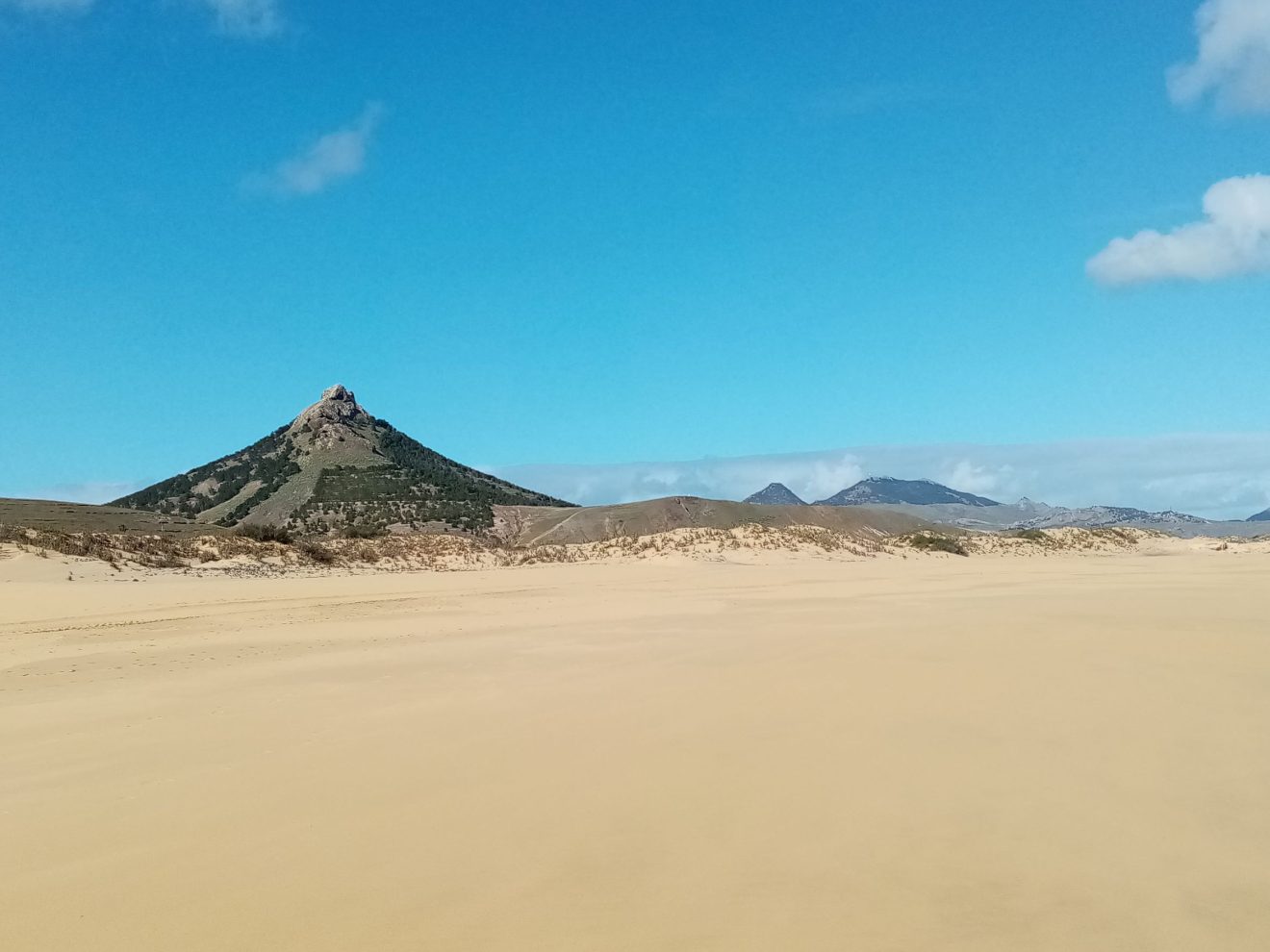
Porto Santo’s beach will become a testing ground for three coastal protection methods under a €2.1 million project designed to tackle erosion and strengthen the island’s natural sea defences.
The work combines the reuse of sand dredged from Porto de Abrigo, the addition of sand to Fontinha beach and the restoration of dunes at Ponta-Calheta.
Regional Secretary for Tourism, Environment and Culture Eduardo Jesus visited the works, which involve moving around 170,000 cubic metres of sediment. The Regional Directorate for the Environment and Sea is overseeing the intervention, financed through the LIFE DUNAS and Sustainable Beach projects.
Each method will undergo technical and environmental monitoring to establish which approaches are best suited to Porto Santo’s coastline and guide future work.
“We are testing different methodologies, with well-defined objectives and prolonged monitoring, because coastal protection requires continuity, scientific knowledge and adaptability,” Eduardo Jesus said.
Approximately 75,000 cubic metres of sediment will be dredged from Porto de Abrigo and deposited underwater off the beach, between the desalination plant and the pier. The aim is to improve navigation in the harbour while replenishing sand within the beach and dune system.
A similar operation took place in 2017, when sediment removed during harbour dredging was used to replenish the beach.
Dredging began during the work window between the 19th and the 24th of October, taking advantage of the Lobo Marinho ferry’s absence. This part of the project is expected to be completed by the 15th of November.
At Fontinha, opposite the Urban Park, sand will be placed directly onto the beach. This is the first trial of this replenishment method in Porto Santo.
Around 7,800 cubic metres of sand will be brought from designated extraction areas off the island’s south coast.
Studies have examined the sand’s suitability, grain size and quality, alongside the potential effects of extraction on marine ecosystems.
An expert from the Portuguese Environment Agency will monitor the work, scheduled to take place between the 10th and the 12th of November, after the site has been set up and access restricted.
Monitoring will track how the added sand moves and how the beach responds, helping to establish whether the technique could be used elsewhere.
At Ponta-Calheta, the LIFE DUNAS project will test the reconstruction of the dune system using around 87,000 cubic metres of sand from a previously assessed extraction area.
Dunes help maintain the beach’s sand balance and provide a natural barrier against waves and severe weather. The trial will assess how effectively they can be restored and whether the approach could be repeated elsewhere in Porto Santo or Madeira.
Sand placement and dune reconstruction are scheduled to take place between the 25th of October and the 17th of November.
The project draws on a study of Porto Santo’s sediment dynamics, which suggests that adding moderate quantities of sand could help counter erosion, provided the results are monitored over time.
Existing monitoring has identified small but persistent retreats of the shoreline, linked to natural beach processes and a gradual reduction in the sand available within the dune system. Rising sea levels are another consideration, with an increase of around 20 centimetres recorded in Madeira since 1970.
Monitoring will continue until 2028, tracking changes in the intervention areas, sediment volumes and any effects of sand extraction on marine ecosystems.
A specialist team will supervise the work, with oversight from the Regional Secretariat for Tourism, Environment and Culture, the Maritime Authority and LIFE DUNAS partners, including the University of Lisbon’s Faculty of Sciences.
Eduardo Jesus said the project should deliver practical improvements to coastal protection while providing evidence to support better decisions about future interventions.
Samantha Gannon
info at madeira-weekly.com
Views: 22