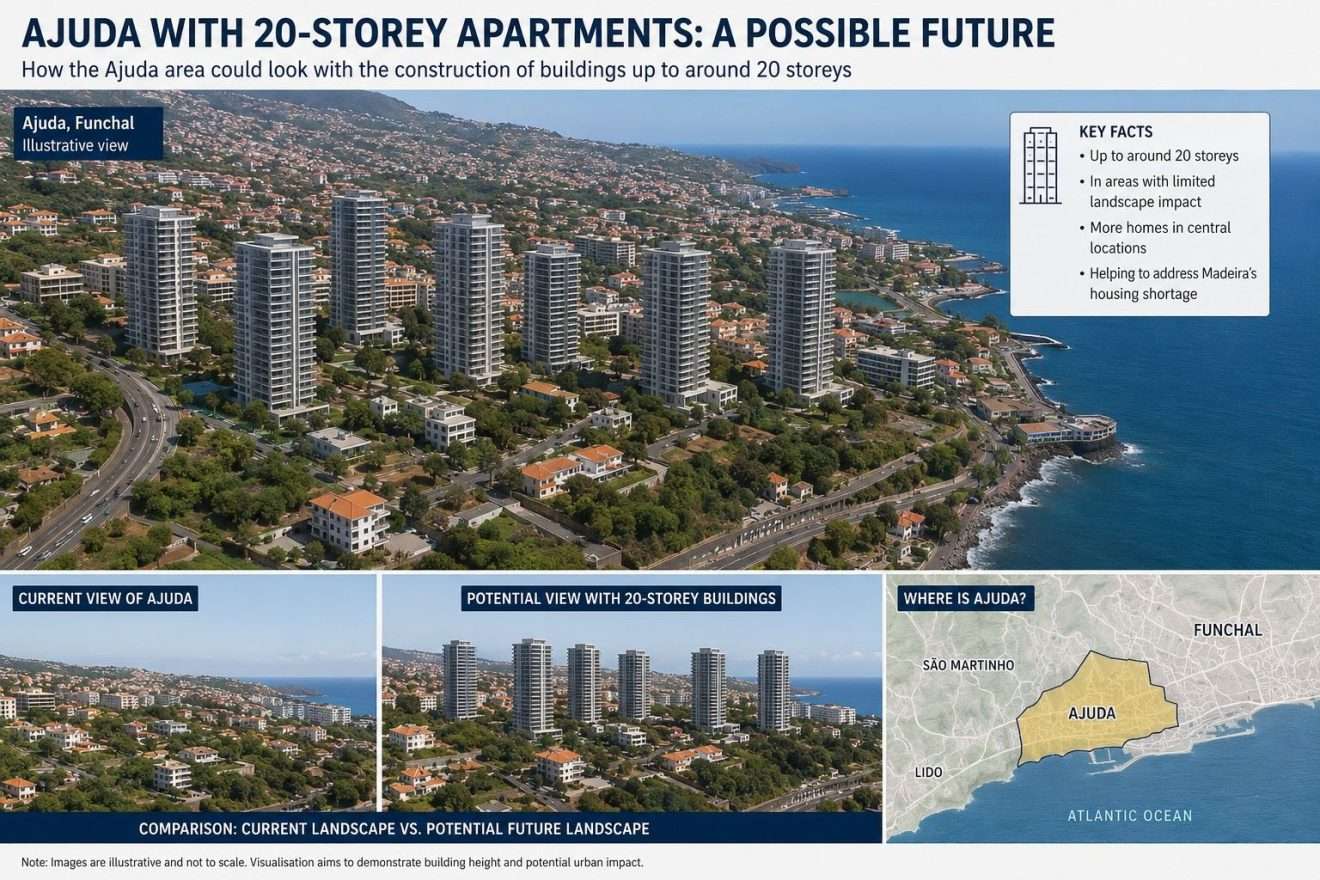
Miguel Albuquerque has defended allowing taller buildings in suitable areas of Funchal, as Madeira’s Legislative Assembly debated a petition proposing a general limit of ten storeys.
Speaking on Tuesday, the 20th of October, during the handover of 25 homes in Ribeiro Real, Câmara de Lobos, the President of the Regional Government said building upwards could increase housing supply, provided the necessary infrastructure was in place, and the landscape was protected.
“There are certain areas where we can build at height,” he said, arguing that proposals should be assessed “not with demagoguery, but with common sense.”
His comments came as regional deputies considered the collective petition “For the Safeguarding of Madeira’s Urban Model,” whose first signatory is former deputy Nuno Morna. Morna attended the parliamentary debate from the public gallery.
The petition proposes limiting new buildings in Madeira to ten storeys as a general rule and offers alternatives to taller development. It followed Albuquerque’s public support for building at height as a response to the region’s housing problems.
During the debate, JPP deputy Luís Martins welcomed the opportunity to examine the issue in parliament, saying the petition raised questions requiring public and reasoned discussion.
He argued that it had not been demonstrated that taller buildings would resolve the housing shortage and questioned whether existing infrastructure could accommodate more intensive development.
The JPP believes housing policy should prioritise measures including the rehabilitation of existing buildings. Although the party is not opposed in principle to taller construction in clearly defined and justified circumstances, it does not support making it the general approach.
The debate also comes amid questions about how Funchal’s housing strategy will fit with the Regional Government’s proposed landscape planning and management programme.
Earlier this month, Independent Funchal councillor Jorge Afonso Freitas described a potential contradiction between municipal efforts to increase building capacity and a regional policy intended to protect the landscape.
He recalled that the council had suspended provisions of its Municipal Master Plan (PDM) to help address the housing crisis. Freitas said he had supported allowing taller buildings where the additional construction capacity was tied to the provision of homes at controlled prices.
However, he questioned how that approach would align with the landscape programme announced by the Regional Secretary for Economy, Tourism and Culture, Eduardo Jesus. Such plans, he argued, generally introduce measures to restrict building volumes and protect views.
“On the one hand, the City Council takes a whole series of measures to allow greater building capacity and taller construction to address housing, and now a government plan comes along that points in the opposite direction,” he said.
While stressing the importance of protecting the landscape, Freitas called for closer coordination between municipal and regional policies. He urged Funchal City Council to take an active role in the public consultation on the future programme and help shape its implications for the municipality.
He also defended the council’s autonomy over land-use planning, arguing that any regional framework must be compatible with Funchal’s housing and development strategy.
Samantha Gannon
info at madeira-weekly.com
Views: 113