A ferry link between Madeira and mainland Portugal should be assessed as a public service and strategic transport connection, rather than simply as a commercial passenger operation, according to speakers at the JPP’s parliamentary conference on ferry services and territorial continuity.
The debate centred on the economic and financial study commissioned by the Institute for Mobility and Transport (IMT), which examined six possible operating scenarios. None would generate sufficient commercial revenue to cover its investment and operating costs without public funding.
However, speakers argued that this does not necessarily prove that a ferry is unviable. Instead, they questioned whether the assumptions used in the study adequately reflected the potential importance of freight, the wider economic benefits for Madeira and alternative routes involving the Canary Islands.
Of the six scenarios examined, the least financially negative envisaged a fortnightly seasonal service, initially between Madeira and Portimão and later transferring to Setúbal. It produced an estimated negative financial net present value of €18.59 million.
A year-round weekly service would offer the greatest continuity and serve the most passengers, but would also require substantially more public funding, with an estimated negative financial net present value of €144.21 million.
The study consequently concluded that any future service would require a clearly defined public-service model, including the division of financial risks and a mechanism for compensating the operator.
Freight could be crucial
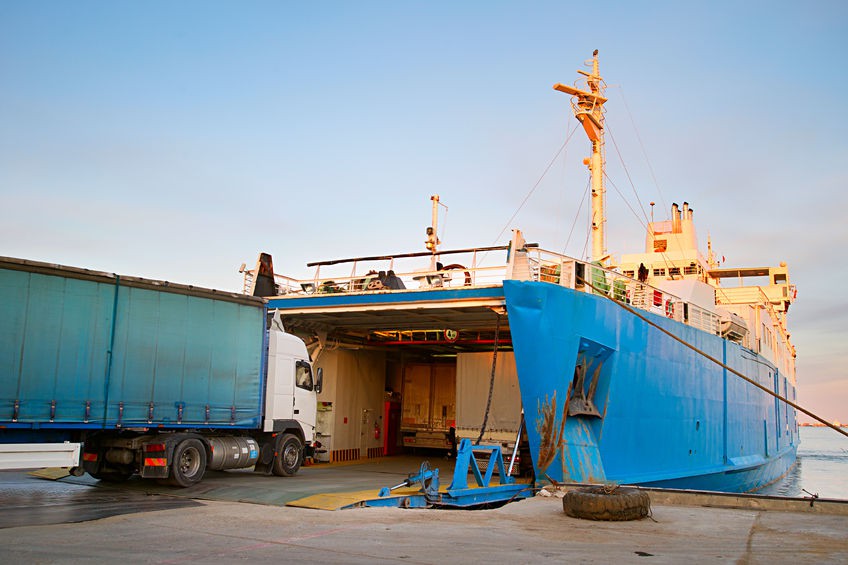
A recurring criticism during the conference was that the study placed too much emphasis on passenger numbers while treating roll-on, roll-off freight, including lorries and trailers driven directly aboard, as a secondary source of income.
Economist João Guilherme Ribeiro argued that this approach should be reversed, with freight providing the financial foundation of the operation and passengers forming a complementary part of the service.
According to Ribeiro, the study attributed only between 2% and 5% of projected revenue to roll-on, roll-off freight and assumed a market share of approximately 4.7%. He presented an alternative calculation suggesting that capturing around 10% of Madeira’s freight market could bring the operation closer to financial balance.
That share, he estimated, would represent approximately 100,000 tonnes of goods or between 4,600 and 4,700 lorries a year, counting cargo travelling in both directions.
Ribeiro also questioned the freight prices used in the study. His comparison with routes including Barcelona–Palma de Mallorca, Cádiz–Tenerife and Stockholm–Tallinn indicated an average charge of €3.33 per nautical mile for heavy or containerised freight. The Madeira study, he said, used a figure of approximately 75 cents.
These remain Ribeiro’s calculations and proposed assumptions rather than conclusions established by the official study.
Paulo Melich Farinha, who has professional experience in the maritime sector, similarly argued that a ferry should be considered part of Madeira’s freight infrastructure and not simply an alternative way for residents to travel.
He said roll-on, roll-off transport could reduce some of the handling required by container shipping, as trailers and their goods remain together during the voyage. A ferry could also carry regional exports to the mainland, rather than depending solely on goods entering Madeira.
Farinha referred to an earlier proposal to export approximately 1,000 tonnes of Madeiran sweet potatoes as an example of outward freight that could be included in future calculations.
He also recalled the Naviera Armas service, which connected Madeira with the Canary Islands and Portimão between 2008 and 2011. In addition to local passengers, the route attracted European tourists who travelled to Madeira in their own vehicles.
Farinha argued that such a service could therefore create demand of its own, rather than merely serving people who already wish to travel between Madeira and the mainland.
Proposal for a triangular route
One alternative discussed was a triangular service linking mainland Portugal, Madeira and the Canary Islands.
Ribeiro argued that adding the Canaries could distribute investment and operating costs across a larger market. He called for discussions with the Canary Islands authorities or an international public tender to test interest among existing European ferry operators.
The proposed model would combine several measures: a greater share of the freight market, traffic in both directions, reduced or waived port charges and public mobility support covering the transportation of passengers’ vehicles as well as the passengers themselves.
Nuno Morna also advocated a freight-based connection involving Madeira, the Azores and the Canaries, recalling a proposal he presented in 2024 for formal discussions between the three archipelagos.
Study’s assumptions questioned
Speakers also raised concerns over the age and range of the information used to estimate costs.
The study reportedly drew heavily upon figures from 2018 and 2019, subsequently updated to present values. Critics argued that ship availability, fuel, maintenance, financing and operating costs have changed sufficiently to justify obtaining new quotations directly from several international shipowners.
The JPP had previously complained that the Grupo Sousa was the only shipowner consulted during the preparation of the study. It has called for evidence to be gathered from other companies, as well as freight operators and major supermarket groups, to establish the level of commercial demand more accurately.
Maritime transport specialist Fernando Grilo also questioned the study’s five-year assessment period, the transparency of some of its data sources and the method used to estimate passenger demand.
He said the assessment should include indirect benefits such as improved competition, economic resilience and environmental effects. He also argued that the next stage should be the development of a properly defined project capable of being presented to potential operators and funding bodies, rather than simply commissioning another general study.
Sousa Group prepared to consider tender
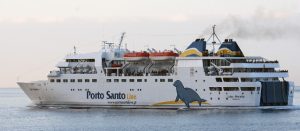
Grupo Sousa did contribute to the conference. Carlos Perdigão Santos, executive director of Porto Santo Line, said the group would examine the terms of any future international tender and could submit a bid if the proposed operation and funding arrangements proved economically sustainable.
He nevertheless questioned the suggestion that a 10% freight share had been conclusively achieved or identified as viable during previous operations, saying the historical figures should be verified.
Santos also cautioned against considering the study’s limit of 40 lorries per voyage in isolation. Space aboard a ferry would have to be divided between commercial freight and passengers’ vehicles. He suggested that a possible configuration might allocate approximately two-thirds of the vehicle deck to freight and one-third to cars.
He added that Grupo Sousa’s container ships already have cabins enabling a limited number of passengers to travel by sea between Madeira and the mainland, although this is not equivalent to a conventional ferry carrying passengers and their own vehicles.
“A political choice”
Closing the conference, JPP president Lina Pereira said the study had established that the six models examined were not commercially profitable, but had not proved that every possible ferry operation would be unviable.
She argued that the wider effects of a regular service should be assessed, including possible reductions in logistics costs, increased competition in freight transport, greater resilience in Madeira’s supply chain and the ability of residents to travel with their own vehicles.
Pereira acknowledged that public funding might be required but said any subsidy should be based on a more detailed analysis of the vessel, route, freight market and operating model.
“The choice is political,” she said, arguing that the central question was not simply whether a ferry could make a profit, but how much territorial continuity was worth to the people of Madeira and Porto Santo.
She accused the PSD Regional Government of abandoning what had previously been one of its political priorities and said the JPP would continue to press for alternative operating and funding proposals.
The debate goes on.
Samantha Gannon
info at madeira-weekly.com
Views: 79