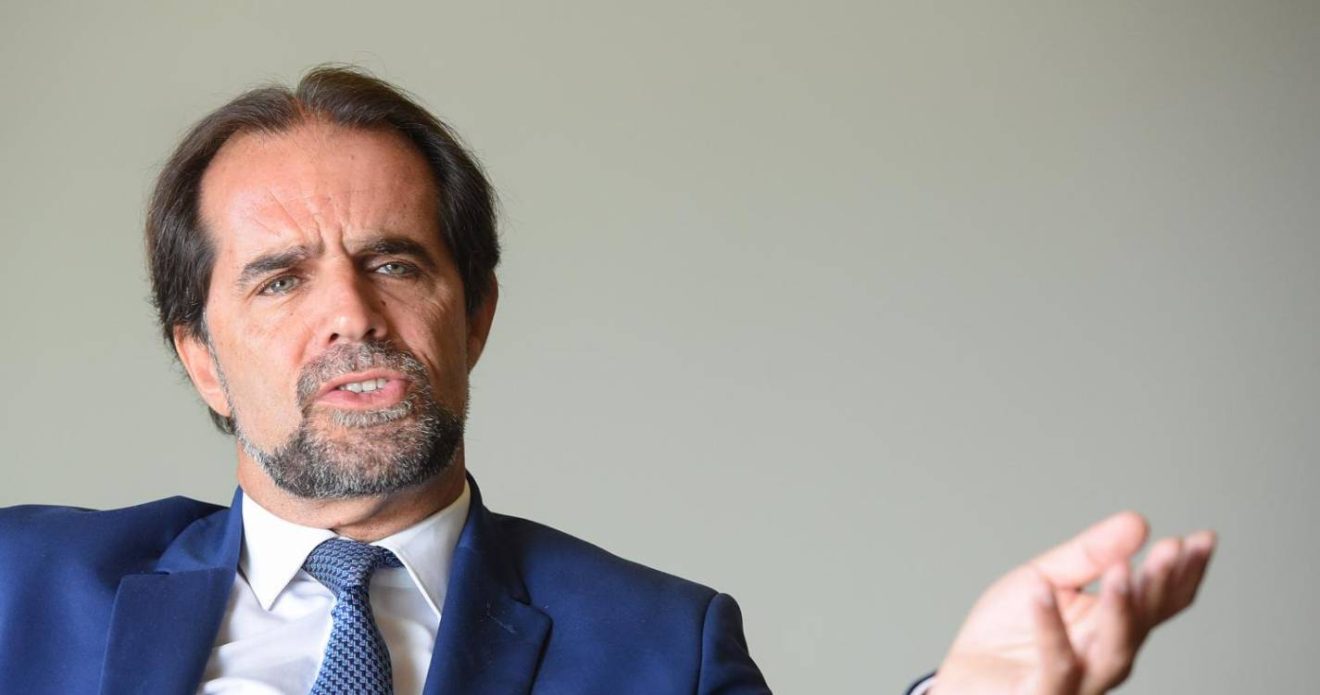
The President of the Regional Government, Miguel Albuquerque, has defended the principle of the presumption of innocence, insisting that investigations and media reports should never be confused with proof of wrongdoing.
Speaking to journalists on the sidelines of the Madeira Agricultural Fair, Albuquerque was asked whether, if he were Prime Minister, he would retain a minister facing the level of political scrutiny currently surrounding the Minister of Internal Administration, Luís Neves.
The controversy stems from recent reports concerning Operation Ab Initio, an investigation initiated while Luís Neves was National Director of the Judicial Police (PJ). The case has prompted questions from opposition parties over his relationship with a construction contractor and the awarding of contracts during his time leading the PJ. The Minister has denied any wrongdoing, while the Government has maintained confidence in him, stressing that the appropriate legal process should be allowed to take its course.
Rather than commenting directly on the political controversy, Albuquerque said he had long adopted a simple principle.
“I have a principle that I adopted a long time ago: news is not convictions, nor are investigations, nor even accusations,” he told reporters.
When journalists pointed out that the investigation contained indications which had fuelled public debate, Albuquerque rejected the suggestion that these should be treated as evidence.
“Indications are indications. Today you can create whatever indications you want,” he said. He went on to cite artificial intelligence as an example of how technological advances are making it increasingly difficult to distinguish between genuine and fabricated material.
“I can take an image created by artificial intelligence and say that you stole a car,” he remarked, arguing that apparent evidence can no longer be accepted at face value without proper verification.
Albuquerque’s comments reflected a broader defence of the rule of law, maintaining that legal processes should be allowed to run their course before political or public judgments are made.
When asked directly whether he would keep the current minister in office if he were Prime Minister, Albuquerque declined to speculate, replying simply: “I am not the Prime Minister.”
His remarks come at a time of increasing debate over the balance between political accountability and the presumption of innocence. While allegations against public office holders often generate intense public scrutiny, the principle that individuals are innocent until proven guilty remains one of the cornerstones of Portugal’s legal system.
By focusing on due process rather than the political merits of the case itself, Albuquerque sought to underline the distinction between allegations, investigations, and proven facts, arguing that decisions should ultimately be based on evidence tested through the justice system rather than on media coverage or public pressure.
Samantha Gannon
info at madeira-weekly.com
Views: 17