By 2100, the Autonomous Region of Madeira (RAM) is expected to have only 123.3 thousand inhabitants, meaning it will lose more than half of its population over 75 years. Population projections from 2025 to 2100 also indicate a significant intensification of demographic aging.
The data, published by the Regional Directorate of Statistics of Madeira, is based on a study by the National Institute of Statistics (INE), which released today the results of the most recent 2025 – 2100 Resident Population survey, disaggregated by sex and age, for Portugal and NUTS II regions.
The evolution of the population in the Autonomous Region of Madeira follows the national decrease trend. “In the central scenario, it is expected that the Madeiran population will drop from 259.4 thousand people in 2024 to 123.3 thousand people in 2100.” This means that during a period of 75 years, the island’s population will be reduced by 52.5% equating to a loss of 136.2 thousand people.
“In the low scenario, the population loss will be even more pronounced as a result of the reduction in fertility levels and the maintenance of very low migratory balances. The result of this could leave a population of 91,300 people in 2100. The results are based on demographic evolution.
Already in the high scenario, the decrease will be less pronounced, mainly due to a recovery in fertility levels in conjunction with positive migration balances. This means the resident population could account for 158,000 people.
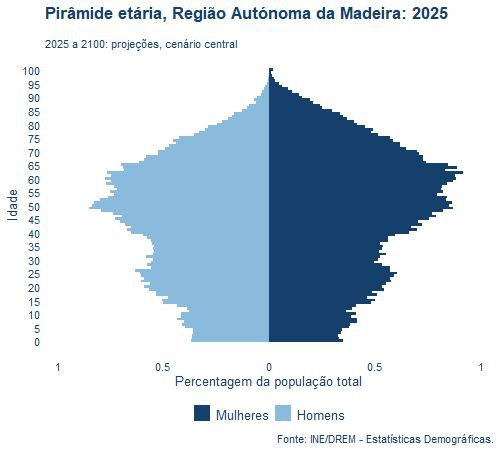
In addition to the decline in population, “profound changes in the age structure of the population of the Autonomous Region of Madeira will become apparent due to demographic ageing over the decades.
62% less children and young people
Between 2024 and 2100, the number of young people in the region (0-14 years old) will decrease from 31.0 thousand to 11.8 thousand, a drop of 62%. As for the number of elderly people (65 years or older), it will decrease from 55.3 thousand to 52.0 thousand, according to the central projection scenario.
In the same scenario, the working-age population (15-64 years) could decrease by about 114 thousand people, from 173.1 thousand in 2024, to 59.5 thousand in 2100.
The aging rate more than doubles in 75 years
With a sharper decline in the youth population compared to the elderly, the study highlights significant aging in the Autonomous Region of Madeira. In the central scenario, the ratio of elderly to young people is projected to rise from 179 in 2024 to 442 in 2100, more than doubling. Nationwide, this index will increase from 192 to 316, remaining lower than that of the region.
In the same scenario, life expectancy at birth for men is expected to increase from 75.87 years in 2024 to 86.70 years in 2100. Equally, an increase in life expectancy at birth for women is expected to be from 82.08 years to 92.11 years.
Samantha Gannon
info at madeira-weekly.com
Views: 60