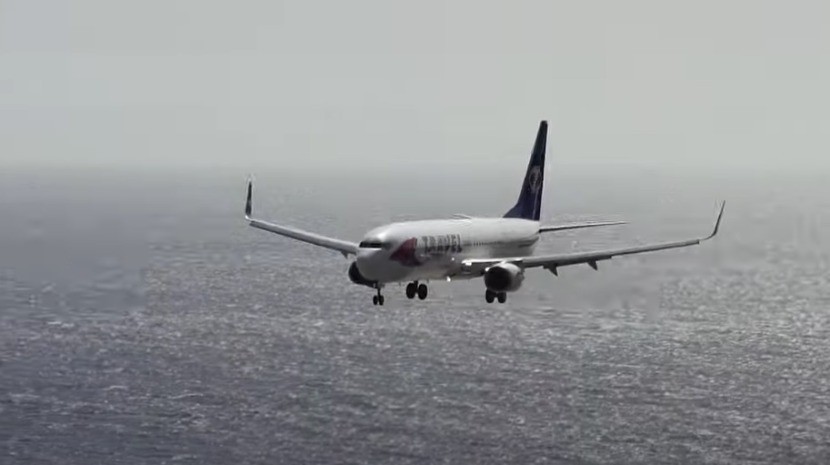
A flight from Madeira to Frankfurt, Germany, was aborted this afternoon just minutes after take-off, reportedly because a bird flew into one of the plane’s engines.
The TUI Fly aircraft took off from Madeira at 17:55 but was forced to return to the airport due to the incident, known in aviation as a “bird strike.” The plane landed safely back on the runway at 18:36.
This appears to be the second bird strike at Madeira Airport in just two days. Yesterday morning, another bird was sucked into the engine of a Ryanair plane during take-off. The incident was caught on video by the YouTube channel Madeira Airport Spotting.
In aviation, a bird strike refers to a physical collision between an aircraft and one or more birds (or other airborne wildlife). While the vast majority of these encounters result in no damage to the aircraft, bird strikes pose a significant safety challenge and cost the global commercial aviation industry upwards of $1 billion annually (Metz et al., 2020). Because approximately 88% to 95% of bird strikes occur at lower altitudes, specifically below 2,500 feet, during take-off, initial climb, approach, and landing. (Metz et al., 2020).
1. Types of Bird Strikes
Aviation authorities and researchers generally classify bird strikes based on the volume, species mass, and nature of the encounter:
- Single-Bird Strikes: The aircraft impacts an isolated bird. While common, the severity depends almost entirely on the bird’s mass and the relative speed of the aircraft during the collision.
- Flock Strikes (Multiple Impacts): The aircraft flies through a dense group of birds, such as gulls or starlings. Flock strikes are disproportionately more hazardous because they can cause simultaneous damage to multiple critical areas, such as clogging both engines or severely compromising the airframe’s integrity (Metz et al., 2019).
- High-Mass Strikes: Involving large waterfowl, birds of prey, or swans. Due to their extreme weight, even a single impact from these species can exceed the certification thresholds of modern aircraft structures.
2. Engine Ingestion
Modern jet engines operate using high-bypass turbofans. When a bird is sucked into the intake, it can bend or break the rapidly spinning titanium fan blades. If a blade snaps, it can cause catastrophic internal destruction, engine stalls, fires, or a complete loss of thrust. While engine stops occur at relatively low rates globally, they represent the highest operational risk for commercial jet transports (Oruç et al., 2022).
Airframe and Leading-Edge Damage
Surfaces first exposed to the aerodynamic flow, such as the nose cone (radome), wing leading edges, and the tail unit (empennage), absorb the brunt of the physical force. Heavy impacts can crush the metallic or composite skin, distorting the aircraft’s aerodynamics and potentially jamming primary flight control surfaces (Oruç et al., 2022).
Windshield Penetration and Instrument Obstruction
For commercial airliners, windshields must be engineered to withstand rigorous impact testing without allowing penetration (Cardoso et al., 2022). However, in smaller general aviation aircraft, bird strikes frequently shatter the windshield, leading to severe pilot injuries. Additionally, birds can strike and bend pitot tubes (airspeed sensors). If these tubes become blocked, flight crews lose accurate airspeed indications, triggering a complex instrument emergency.
3. Precautionary Measures (Prevention)
The aviation industry uses a multi-layered prevention framework divided between airport ground operations and aerospace manufacturing regulations.
Airfield Habitat Management
Airports actively modify the local environment to make the airfield explicitly unappealing to wildlife (Allan, 2000):
- Grass Management: Maintaining airfield grass at specific heights prevents small flocking birds from accessing seeds while hiding rodents from predatory raptors.
- Water Mitigation: Eliminating open drainage ditches or standing ponds near runways to deter waterfowl from settling.
Active Deterrence and Technology
- Acoustic and Visual Controls: Wildlife control teams use pyrotechnics, gas cannons, and recorded distress calls to disperse birds safely.
- Falconry: Many international hubs employ trained falcons to naturally scare away territorial birds.
- Avian Radar: Advanced radar systems track real-time bird movements around the airport perimeter, allowing air traffic control to hold departures if a dense flock crosses the flight path.
Structural Certification Requirements
Before an aircraft can be certified airworthy by bodies like the Federal Aviation Administration (FAA) or the European Union Aviation Safety Agency (EASA), it must pass stringent strike requirements (Cardoso et al., 2022):
- Transport Category Airframes (Part 25/CS-25): The structure and empennage must guarantee the capability of continued safe flight and landing after striking a 4 lb (1.8 kg) bird—and up to an 8 lb (3.6 kg) bird for the tail unit—at design cruise speeds (Cardoso et al., 2022; Metz et al., 2019).
- Engine Rig Testing: Manufacturers test engines by firing bird carcasses from pneumatic cannons into active, running turbines to ensure the housing safely contains any internal engine failures without exploding.
4. Emergency Measures (In-Flight Response)
When an unavoidable bird strike occurs, flight crews rely on strict standard operating procedures (SOPs).
Time-Critical Decision Making
- If a bird strike occurs during the take-off roll before reaching $V_1$, the captain will immediately abort the take-off, deploying maximum braking and reverse thrust to stop safely on the runway.
- Above $V_1$: If the aircraft has passed $V_1$, it is moving too fast to stop safely on the remaining runway. The crew must continue the take-off, stabilize the aircraft in flight, and then coordinate an emergency return landing.
Core Pilot Protocol
Pilots strictly adhere to the operational hierarchy: Aviate, Navigate, Communicate.
- Aviate: The flying pilot focuses entirely on maintaining safe pitch, attitude, and airspeed, ignoring visual distractions or cockpit noise.
- Controllability Check: If structural airframe damage is suspected, pilots will climb to a safe altitude and perform a flight handling check at lower speeds to ensure the aircraft remains controllable during the landing approach.
- Windshield Management: If a windshield pane is fractured but not breached, pilots will turn on internal window heating to maximize the pliability of the glass layers and reduce airspeed to limit wind resistance against the weakened structure.
References
Allan, J. (2000). A protocol for bird strike risk assessment at airports. Proceedings of the International Bird Strike Committee, 1-13.
Cardoso, S. H. S. B., Oliveira, M. V. R., & Godoy, J. R. S. (2022). eVTOL certification in FAA and EASA performance-based regulation environments: A bird strike study-case. Journal of Aerospace Technology and Management, 14, e1271. https://doi.org/10.1590/jatm.v14.1271
Cited by: 33
Metz, I. C., Ellerbroek, J., Mühlhausen, T., Kügler, D., & Hoekstra, J. M. (2019). Analysing bird strikes in fast-time. Proceedings of the North American Bird Strike Conference, 17, 1-12.
Metz, I. C., Ellerbroek, J., Mühlhausen, T., Kügler, D., & Hoekstra, J. M. (2020). The bird strike challenge. Aerospace, 7(3), 26. https://doi.org/10.3390/aerospace7030026
Cited by: 137
Oruç, R., Aktemur, Ş., Yaşar, M., & Kanat, Ö. Ö. (2022). Birds vs. Metallic Birds: A review of bird strikes in aviation. Journal of Aviation, 6(2), 372-379. https://doi.org/10.30518/jav.1152384
Cited by: 8
Samantha Gannon/Gemini AI content for the section relating to aviation bird strikes
info at madeira-weekly.com
Views: 34