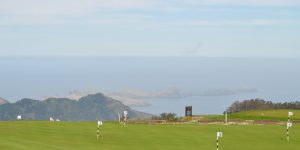
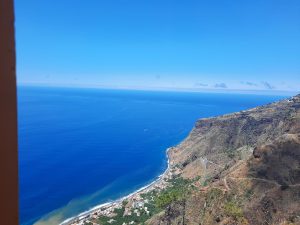
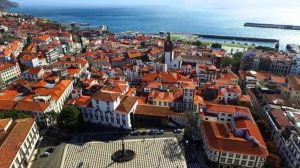
Juntos pelo Povo (JPP) published the economic and financial feasibility study for the Ponta do Pargo Golf Course on its Transparency Portal on Sunday, the 22nd of November. Party leader Élvio Sousa invited the public to read the report and asked how much of the money invested in the project Madeira could expect to recover.
“After so many millions of euros invested, how much will the concessionaire pay and how much will the Region recover?” Sousa asked.
The study, prepared by Quest21 II Consulting for the publicly owned company Ponta do Oeste, was reported by DIÁRIO in its 19th of November print edition. It found that the project was financially unviable for the public promoter, with a negative financial result of €48 million. Its baseline scenario estimated a positive economic net present value of €54.5 million for Madeira when wider costs and benefits were taken into account.
Sousa said he had no objection to golf but considered the Regional Government’s spending on golf infrastructure excessive. According to JPP, public investment amounts to €60 million in Ponta do Pargo, €36 million in Faial and €22 million in Porto Santo, a total of €118 million. Sousa said the Regional Budget funds land acquisition, infrastructure and access roads, while private operators are ultimately entrusted with running the facilities. He also questioned the sector’s profitability, saying it generated €4 million in 2025.
In a statement, the Regional Secretariat for Equipment and Infrastructure described coverage published on the 18th and 19th November as “partial and reductive.” The secretariat, led by Pedro Rodrigues, said the study assessed the project’s social and environmental effects alongside its financial and economic performance.
The secretariat said the project’s economic net present value was positive in all three scenarios modelled. It was estimated at €41.5 million in the conservative scenario, €54.5 million in the baseline scenario and €72.1 million in the optimistic scenario. The economic internal rate of return ranged from 9.5% to 15.9%, above the 4% social discount rate used in the assessment.
The study projects €138 million in one-off economic activity from property sales and construction. It also estimates an annual economic contribution of between €16.7 million and €18.9 million from concession rent, golf and hotel operations, catering and tourism-related trade.
The project is forecast to support 634 jobs, including 307 direct and 327 indirect jobs, with an estimated gross annual wage bill of €11.2 million. The Government said attracting visitors throughout the year could help reduce seasonal fluctuations in tourism and give local businesses and workers greater stability.
The development includes completing the 18-hole golf course, building two five-star hotels and developing a residential area. The secretariat said the project could broaden Madeira’s tourism offering and create opportunities in the west of the island. The study also identifies potential environmental benefits, including landscape restoration, the use of native species, more efficient irrigation and measures to protect natural resources and biodiversity.
The secretariat said the financial assessment measures the public promoter’s direct cash flows, while the economic assessment includes costs and benefits to society. Citing the European Commission’s cost–benefit principles, it argued that the investment decision should take both measures into account.
Samantha Gannon
info at madeira-weekly.com
Views: 5