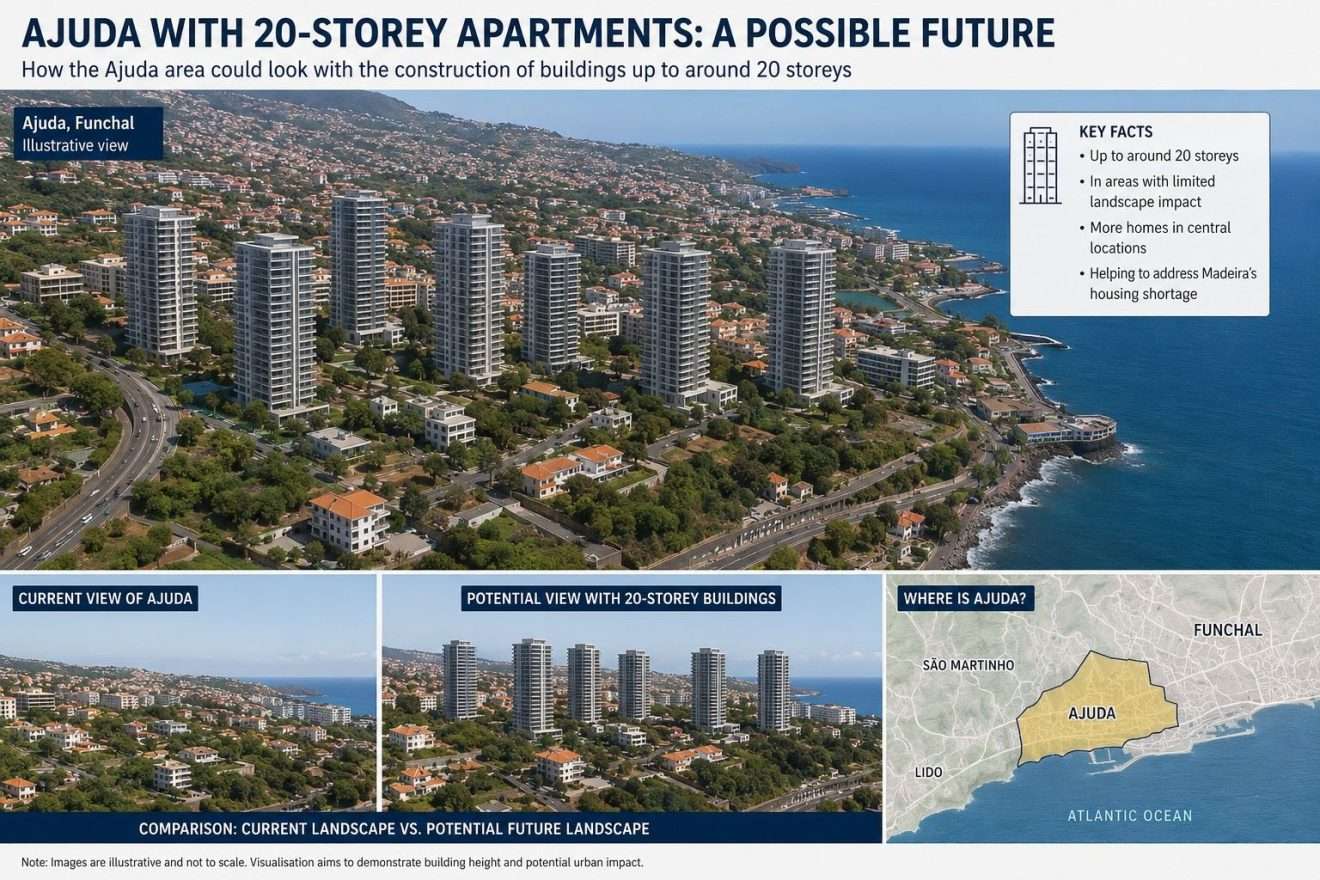
The debate over high-rise construction in Madeira has drawn criticism from PS-Madeira after the Social Democratic majority rejected a proposal to request evidence from professional bodies representing architects, engineers, and technical engineers.
PS-Madeira leader Célia Pessegueiro said the decision meant the parliamentary debate on the petition for the “Safeguarding of Madeira’s Urban Model,” scheduled for tomorrow, would take place without their contribution.
Speaking after a meeting with the regional branch of the Order of Architects, she argued that, while the issue involves political choices, those decisions should also be informed by technical expertise.
She said this was particularly important because changes to planning legislation placed greater responsibility on architects and engineers to sign off projects and supervise construction.
Pessegueiro questioned why the Assembly had refused to hear the professional bodies, arguing that their evidence would help political parties reach better-informed positions.
The PS had also proposed consulting the Regional Directorate for Spatial Planning, the Regional Secretariat for Equipment and Infrastructure and the Association of Municipalities of the Autonomous Region of Madeira. These proposals were also rejected by the majority.
The meeting addressed changes to the Legal Framework for Urbanisation and Building, which came into force on the 1st of October. These alter procedures for submitting projects and increase the responsibilities of technical professionals and municipal councils for inspections.
Pessegueiro warned that problems involving a building’s position or height could be difficult to correct once construction was under way.
The discussion comes against the backdrop of the Regional Government’s position that high-rise construction in selected locations can be compatible with protecting Madeira’s landscape.
In a clarification published on the 8th of October, the Regional Directorate for Spatial Planning rejected suggestions that support for taller buildings contradicted plans for a Landscape Planning and Management Programme.
It said the programme would identify the landscape’s value, vulnerabilities and potential, providing a basis for decisions about development, including where taller buildings might be appropriate.
The government said it did not support indiscriminate high-rise development across Madeira. Instead, it argued that taller buildings could be considered in specific locations identified as technically suitable.
It cited housing needs, more efficient use of limited land, better use of existing infrastructure and reduced urban sprawl among the potential benefits.
The proposed landscape programme would identify areas of particular visual sensitivity, important views, sightlines and skylines, helping establish criteria for development and determine where building heights should be restricted.
The directorate said this approach was consistent with the Regional Government President’s recognition of the Funchal amphitheatre as an area of particular landscape sensitivity. Restrictions there would not, it argued, necessarily justify excluding taller buildings elsewhere.
According to the government, decisions should reflect the characteristics of each location, supported by technical assessment and planning criteria.
The landscape programme has been included in Madeira’s Regional Spatial Planning Programme since 2023 and is also included in the current Government Programme.
For PS-Madeira, however, the immediate concern is that parliament will debate the petition without first hearing the professional bodies whose members would be responsible for designing and overseeing such developments.
Separately, Pessegueiro called for a review of career structures for architects in public administration, arguing that their professional responsibilities justified change and that Madeira could take the lead nationally.
Samantha Gannon
info at madeira-weekly.com
Views: 28